Carlindie Project: Lithium and Gold
Ownership: Several applications still pending grant
Size: ~735km2
Location: 90 kilometres southeast of Port Hedland,
Western Australian along the strike of Wildcat Resources Bolt Cutter Lithium
Project and neighbouring SQM and Kali Metals Pilbara Lithium Project.
Background: Terrain is seeking to fast track
granting of several pending areas and currently has
two tenements granted.
- Terrain has completed a highly successful 200m x 200m maiden soil sampling program along 15km corridor (~60km2) E45/6524, with stage 2 infill soil sampling campaign targeting new priority target covering a 12km commencing in Q3/2026 (see ASX: 01/10/2025 & 04/06/2026).
- Terrain’s Carlindie Project
is under 3m of soil cover and in a favourable geological setting within WA’s
premier Lithium district.
- A Machine Learning study has identified three priority targets as seen in diagram 1.
- Infill soil sampling
program now designed and ready to commence in the second half of 2026.
- Additional
field work to commence as tenements are granted.
Maiden Soil Sampling Program: defines Lithium-caesium target (see diagrams) along the interpreted extension of the tectonic structure that hosts Wildcat Resources’
Tabba Tabba lithium deposit, within ground independently ranked
Priority 1 by RSC’s machine-learning prospectivity study over the
Carlindie Project.
Gold Pathfinder Response: soil grid returned a multi-element gold pathfinder response
(As-Mo-Sb-Cr-Ni), an element suite recognised in published Pilbara
practice for intrusion-hosted and shear-hosted gold styles in
greenstone settings, providing an early indication of gold
prospectivity also aligning with Priority RSC’s machine-learning
prospectivity study.
Strategic
Opportunity: While the Carlindie Project is not Terrain’s
flagship project, it represents a potentially large-scale opportunity for
shareholders. Terrain is advancing the Project through its proven, disciplined
and staged exploration approach, designed to deliver cost-effective value
creation while progressively de-risking the potential for future development.
Terrain applied for these exploration areas,
with approximately half now granted. Much of the ground had remained in
application status since around 2008 and, as a result, largely missed the
recent surge in exploration activity across the East Pilbara region of Western
Australia. This region has attracted significant exploration investment and
delivered multiple new discoveries, including both gold and lithium
mineralisation.
Importantly, the Carlindie Project is located
beneath relatively shallow soil cover and has received very limited systematic
on-ground exploration to date. This provides Terrain with an opportunity to
apply modern exploration techniques, including regional geophysics,
machine-learning targeting and targeted geochemical sampling, to an
underexplored area with established regional geological potential.
Terrain’s
strategy is to advance the Project progressively testing the highest-priority
targets first, using each stage of exploration to refine the geological model
and guide subsequent investment. This approach is intended to maximise the
effectiveness of exploration expenditure while building a stronger understanding
of the Project’s mineral potential.
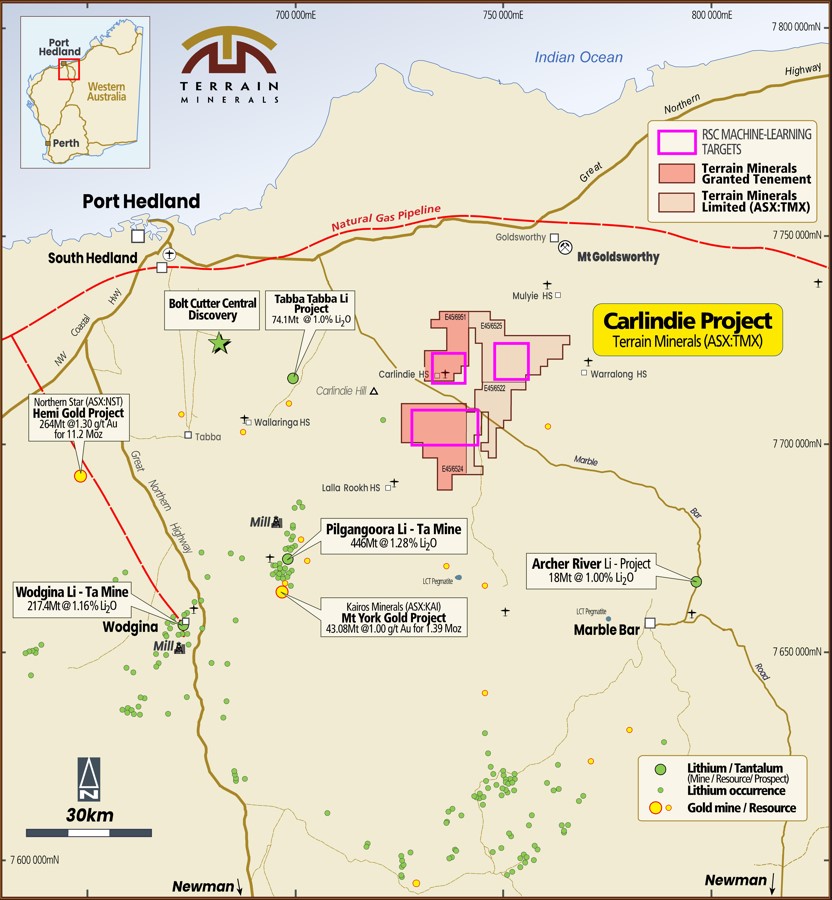
Diagram 1: Terrain Minerals Carlindie Project is located within the Pilbara region
of Western Australia. The region is arguably Australia’s premier address for
lithium mineralisation and hosts significant deposits including Pilbara
Minerals’ Pilgangoora lithium operation and Mineral Resources’ Wodgina lithium
mine as well as Northern Star’s Hemi gold deposit. The Company’s Carlindie
Project is positioned along an interpreted extension of the tectonic structure
that hosts Wildcat Resources’ Tabba Tabba lithium deposit and the recently
discovered Bolt Cutter Central lithium mineralisation.
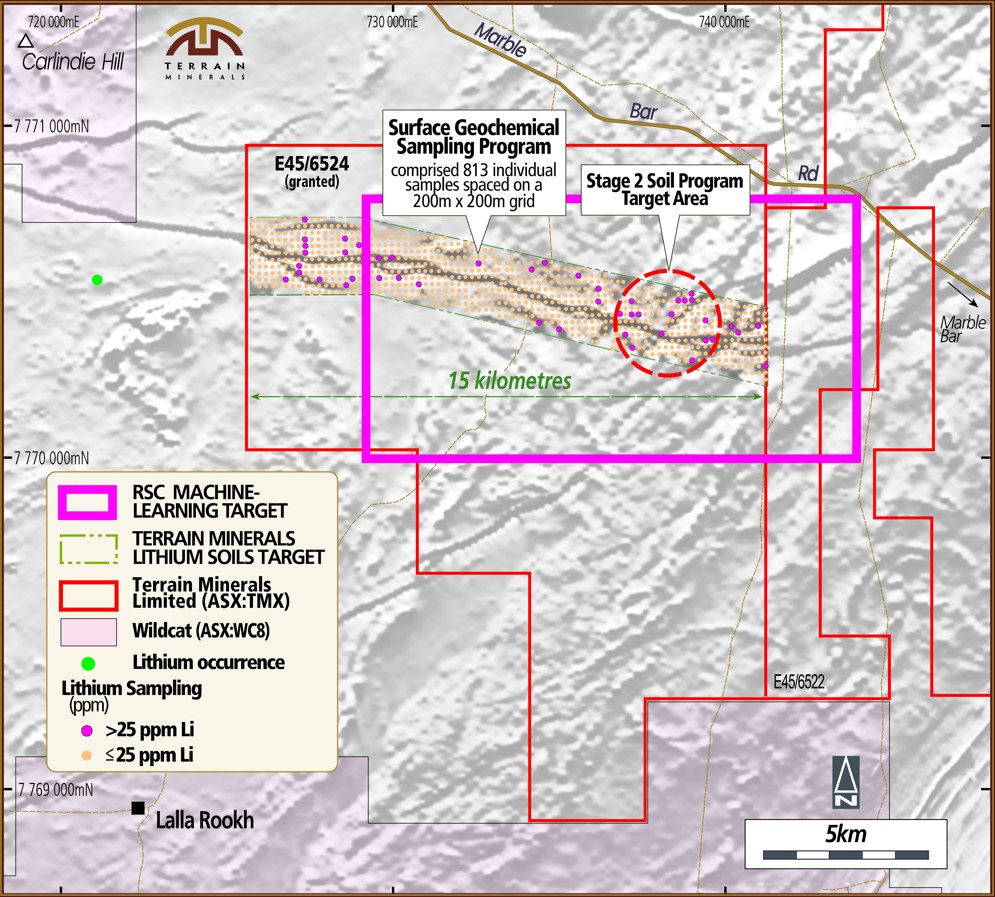
Diagram 2: Terrain Minerals’ E45/6524 tenement, contains
one of three newly identified machine-learning targets, shown in purple. This
target is the only one of the three to have undergone soil sampling, which has
identified new overlapping geochemical targets and further strengthened its
prospectivity.
Terrain Minerals has also processed open-file Western
Australian Government aeromagnetic data, highlighting a significant tectonic
structure associated with Wildcat Resources’ Tabba Tabba lithium deposit that
extends into Terrain Minerals’ 100%-owned Carlindie Project.
These desktop activities identified a 15
kilometre long corridor of prospective geology within tenement E45/6524. The prospectivity of this
tectonic structure (corridor) was further strengthened following Wildcat Resources’ ASX
announcement dated 4 August 2025, which reported multiple lithium-bearing
pegmatite swarms at Bolt Cutter Central. Bolt Cutter Central represents the
western extension of the same tectonic structure that extends into Terrain
Minerals’ Carlindie Project.
The combination of the interpreted regional tectonic structure,
machine-learning targets and overlapping soil geochemical anomalies provides
multiple exploration vectors for lithium-bearing pegmatite mineralisation, as well as gold within E45/6524.
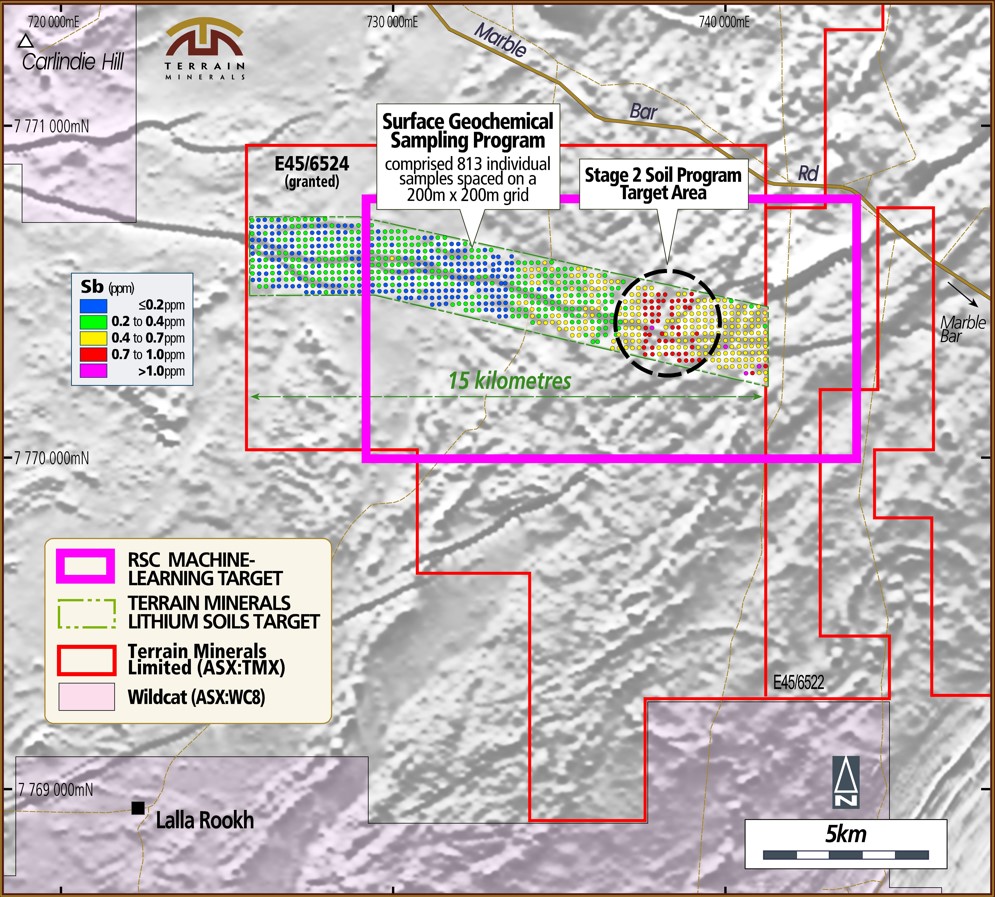
Diagram 3: Above plan of antimony (Sb) in soils across the surveyed
grid at Carlindie, showing the coherent multi-kilometre antimony response
coincident with the arsenic anomaly in the south-eastern part of the
surveyed area, and
consistent with an Archaean orogenic gold pathfinder
signature (see ASX: 01/10/2025 & 04/06/2026).
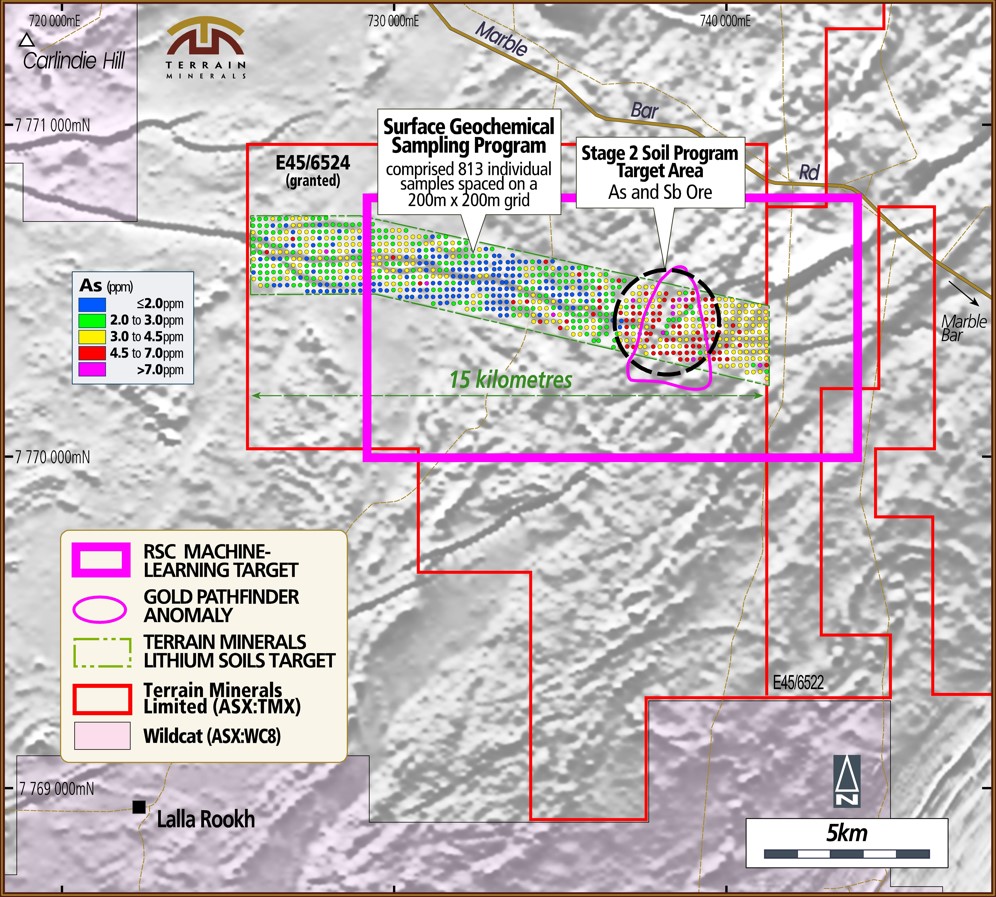
Diagram 4: Above plan
image of arsenic (As) in soils across the surveyed grid at
Carlindie, showing the coherent multi-kilometre arsenic response
defining the south-eastern part of the gold-pathfinder anomaly
footprint (see ASX: 01/10/2025 & 04/06/2026).